45%
Reduction in unplanned equipment downtime through AI-driven predictive maintenance frameworks.
Manufacturing organizations are integrating AI and automation frameworks across production, supply chain, and quality environments to improve throughput, reduce unplanned downtime, and build more resilient operational ecosystems.
Manufacturing organizations face increasing pressure to improve production efficiency, minimize equipment downtime, and maintain quality standards across complex and distributed operational environments.
Generative AI and Industrial IoT are converging to create intelligent manufacturing ecosystems where machines, sensors, and systems communicate in real time — enabling smarter decisions across the production floor.
Organizations are embedding AI into predictive maintenance, quality assurance, and supply chain workflows to reduce waste, improve throughput, and build resilient operations capable of adapting to shifting market conditions.
As Industry 4.0 adoption accelerates, manufacturers are prioritizing connected architectures that bridge legacy OT systems with cloud-native platforms — enabling enterprise-wide visibility and data-driven operational intelligence.
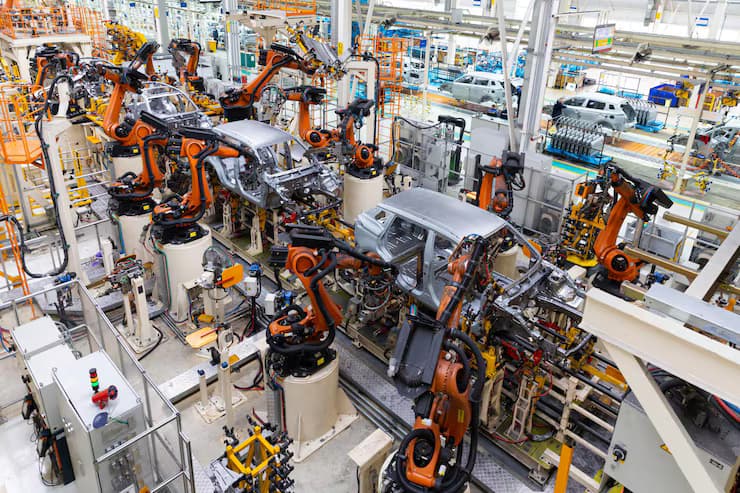
Smart factory environments powered by AI and IIoT are enabling real-time visibility across equipment, processes, and production lines — supporting faster operational decisions and reducing costly inefficiencies.
Manufacturers integrating AI into production workflows are improving OEE, reducing cycle times, and enabling more agile responses to changing demand and process variability across connected facilities.

Predictive maintenance frameworks powered by machine learning are helping manufacturers anticipate equipment failures, reduce unplanned downtime, and optimize maintenance scheduling across production assets.
Automated quality inspection systems are improving defect detection accuracy, reducing manual inspection overhead, and ensuring consistent product quality throughout the manufacturing lifecycle.
AI-driven sensor analytics are enabling manufacturers to predict failures before they occur and optimize maintenance schedules across connected production assets.
Connected factory environments are leveraging AI to improve production coordination, reduce manual intervention, and enable real-time operational visibility across facilities.
Computer vision and AI models are replacing manual inspection processes with faster, more accurate defect detection across production lines.
AI frameworks are improving end-to-end supply chain coordination, demand forecasting, and logistics optimization across global manufacturing networks.
Virtual replicas of physical production assets are enabling manufacturers to simulate changes, test scenarios, and optimize processes without disrupting live operations.
AI-powered energy management systems are reducing consumption across factory operations, supporting sustainability goals and lowering operational overhead.
Manufacturers adopting AI-powered production, maintenance, and quality frameworks are seeing measurable improvements in uptime, throughput, defect rates, and supply chain performance.
45%
Reduction in unplanned equipment downtime through AI-driven predictive maintenance frameworks.
Commitment to measurable outcomes
38%

Their predictive intelligence platform eliminated unplanned downtime and transformed how we manage production across our facilities.
Quality improvement
50%
Faster automated quality inspection cycles versus manual processes across connected production lines.
OEE improvement
30%

Connected technologies, scalable infrastructure, and intelligent operational systems are shaping the next generation of digital transformation across industries.
Schedule a Consultation